What it costs a medical team to stay current
The hours a field medical team spends keeping up with the literature are never counted, never budgeted, and paid several times over. A twenty-year-old study still gives the only honest figure.
Juisci
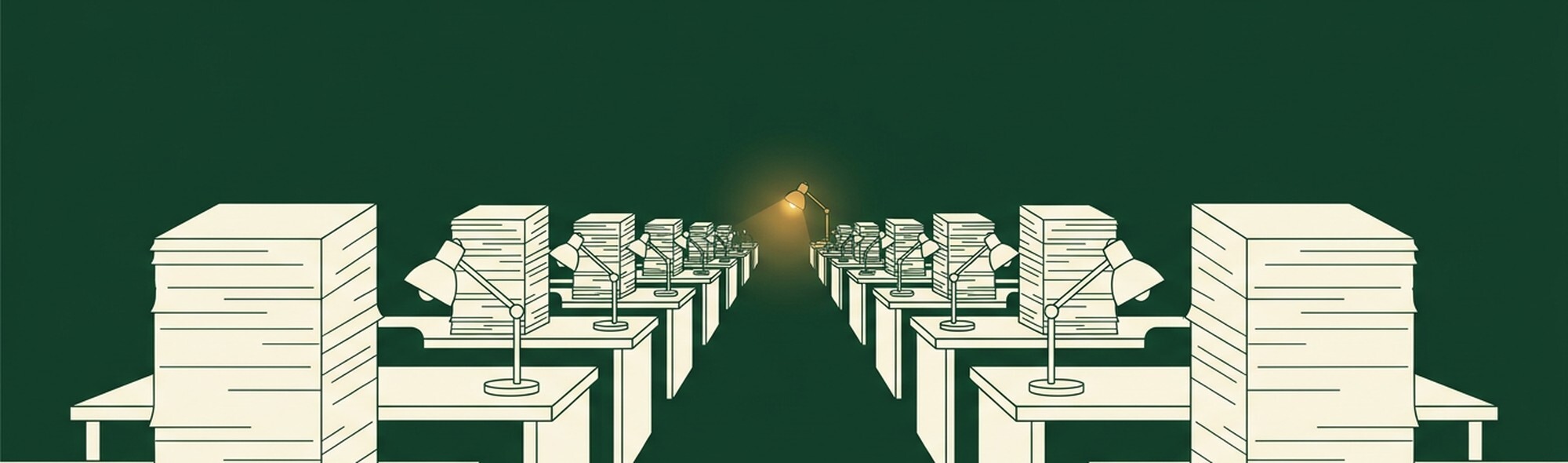
Every medical affairs plan has a line for congresses, a line for publications, a line for advisory boards. None of them has a line for the hours the field team spends keeping up. The work gets done anyway, in the evening, on the train, between two visits. It is real work, it is expensive, and because it is never counted it is never managed.
There is one number worth knowing before anything else.
The arithmetic nobody runs
In 2004, a team led by Brian Alper asked a plain question: how long would it actually take a physician to keep up with the literature relevant to their practice?
They took the journals covered by five primary care review services, counted what came out, and had five physicians appraise fifty randomly selected articles while timing themselves. The answer: 7,287 articles published per month, and 627.5 hours per month for a physician trained in epidemiology to evaluate them.
That is around 3.8 full-time people, doing nothing else. For one specialty. In 2004.
Nobody has published a better figure since, and the volume has not gone down.
Your team does not read everything, and is not supposed to
The objection is obvious: an MSL covers one or two indications, not the whole of primary care. True, and the volume is correspondingly smaller.
What changed is not the volume. It is the deadline.
A field medical team used to be current by the quarter, which was enough because the physicians they met were also current by the quarter. That is no longer the case. The clinician across the desk gets the late-breaking result on their phone the day it is presented, from the same feeds, in the same week. Being a quarter behind used to be invisible. Now it shows in the first ten minutes of a visit.
The expensive part is not reading
Alper's 627.5 hours is not reading time. It is appraisal time.
Reading an abstract takes minutes. Deciding whether a result should change what you say, whether the population matches the one you are asked about, whether the primary endpoint carries the weight the press release gives it, whether the guideline committee has already looked at it and declined to move — that is where the hours go. It is also the part that cannot be delegated to a summary, because the judgement is the deliverable.
This is why "we sent the team the publication" is not preparation. The publication is the raw material. The appraisal is the work.
And the cost is paid several times over
Here is the part that makes the number worse than it looks.
In most organisations, that appraisal happens in parallel. Each MSL builds their own understanding of the same twenty publications, and often their own slide pack to go with it. Same literature, same conclusions, assembled separately by people who rarely compare notes, and rebuilt from scratch at the next congress.
The cost is not 627.5 hours. It is 627.5 hours multiplied by the number of people doing it, minus whatever overlap happens by accident.
And nobody measures any of it
If this were measured, it would be managed. It is not measured.
A global survey of 1,023 medical affairs professionals across 63 countries, published in Pharmacy in 2025, found that 67% consider it "difficult" or "very difficult" to measure MSL performance accurately, and that only 3% describe their current KPIs as "very effective". Only 7% called measurement easy.
What gets counted instead is activity. 92% of organisations track the number of KOL engagements. Yet asked what they would rather measure, respondents named the quality of relationships (70%) and the quality of the insights brought back (67%).
So the meeting is counted. The preparation that makes the meeting worth having is not. A team can be measurably busy and quietly out of date, and nothing in the dashboard will say so.
What would actually change it
Not more content. The problem is not a shortage of publications.
Three things change the arithmetic, and none of them is exotic.
Appraise once, for everyone. One shared, current reference for an indication, maintained by one medical team, rather than fifteen private versions of the same reading. The duplication is the single largest avoidable cost.
Keep the source attached. An appraisal that travels without its reference has to be re-done by whoever receives it. One that carries its source can be checked in seconds and reused.
Make currency a property of the library, not of the person. If being up to date depends on who read what last weekend, it will fail the week someone is on leave.
This is the problem Juisci works on. We maintain a continuously updated body of peer-reviewed literature, selected by our medical team, where each statement carries the source behind it. Companies get a dedicated space in it for their therapeutic area, and their field teams work from the same shelf as the physicians they meet. Selection and accountability stay with us.
If that sounds like it would change how your team prepares, it is worth thirty minutes: book a slot with Robin, our CEO, and Louis, Head of Sales.
Sources: Alper BS, Hand JA, Elliott SG, et al. How much effort is needed to keep up with the literature relevant for primary care? Journal of the Medical Library Association. 2004;92(4):429-437. · Dyer S, Hyder C, Kraemer J. Challenges of Key Performance Indicators and Metrics for Measuring Medical Science Liaison Performance: Insights from a Global Survey. Pharmacy (Basel). 2025;13(2):51. doi:10.3390/pharmacy13020051